This page will feature articles setting out the bodges, er, methods that we, here at the MPLR have learnt thus far. If there is anything in particular you would like to see here, please drop us an email. (address on contacts page)
Small gas tank.
Right then, here goes. Some time ago, No.2 Patrick was consigned to the workshops pending major work to improve his performance. The intention was to fit a PPS gas tank to replace the rather large one Patrick was fitted with. While the large tank worked well, there was a very real risk of running out of water before running out of gas, leading to nasty smells, burnt paint and so on. As it turned out PPS did not have any small tanks in stock so we set about doing a bit of research and below you can read the results. DISCLAIMER:- THIS IS WHAT WE DID, NOT WHAT WE THINK YOU SHOULD DO. WE ARE NOT QUALIFIED ENGINEERS, GAS FITTERS AND SO ON, JUST IDIOTS THAT PLAY TRAINS. IF YOU COPY US AND MEET WITH AN ACCIDENT THAT IS YOUR FAULT, WE ACCEPT NO RESPONSIBILITY AT ALL. YOU HAVE BEEN WARNED, GAS IS DANGEROUS, IF IN DOUBT, DON’T MESS WITH IT. Right, sorry about shouting but we do need to make that bit clear.

Above is a piccy of Patrick with the new gas tank fitted, I rather like the fact that it is so small and that it runs out of gas just before the boiler runs dry. Of course, more testing is needed to make sure this is the case and thus far it has only been tested on the rolling road in the workshops.
I do not intend to provide a course on silver soldering here. I used a company called CuP Alloys. Very helpful and first class service, they also do a DVD that explains everything. They can be found at www.cupalloys.com
Parts list:-
- 22mm copper pipe
- 2 stop ends (unsoldered type)
- silver solder and flux
- gas torch
- gas filler valve and fittings
- Cut your pipe to length (we used stock plumbing pipe from B&Q), using a pipe cutter to avoid burrs cut off about 44mm’s. If using a hacksaw you will need to dash about with a file to clean up the cut edges.
- Then cut down the stop ends to about 8mm or so.
- In one of the stop ends you will need to drill the holes to take whatever fittings you decide to use.
- Fashion two ‘rings’ of silver solder and insert into the tube, push well down so that they sit snugly into the stop ends.
- Apply plenty of flux paste.
- Braze the whole lot in one go, ensuring the tell tale ring of silver solder is clearly visible on every joint.
This size of tank seems to provide about 15 to 20 minutes of gas, with a fairly small flame, just the job for the IP boiler.
The bottom end cap was turned out of a lump of brass bar as I thought this would look neater. It fits snuggly about 2mm up the inside of the main tube, but in retrospect I think simply using two stop ends would have been easier and would have looked just as good after a coat of paint.
Above can be seen the gas tank in situ, still being tested so not yet painted.
One thing I did not do was to drill and braze in a mounting bolt in the bottom stop end, this would have made mounting the tank a lot more solid, back to the epoxy resin I suppose as I can not be bothered to start again now, but if you do this ‘dont forget to fit a bolt through the bottom for mounting’. Hope this first attempt at a ‘how to’ article is helpful, all comments very welcome!
=========================================================
Fuel tanker
We thought the addition of a tanker to supply our stock of diesel engines was overdue. Just in case you are interested, we have added details of its construction below.
We had a set of IP wheels, axle boxes and buffers knocking about in a box, and the weather being horrible decided to spend a day doing this. Great.
First off, the model is based on a generic type rather than any specific prototype. We browsed the web for an hour or so, looking at pics of the real thing and having got the idea into our heads, off we went.
First off, we built the chassis. This is pinned and glued using 8mm section softwood. we have not added dimensions ‘cos if you want to make one, we are sure you will have better ideas than we did.
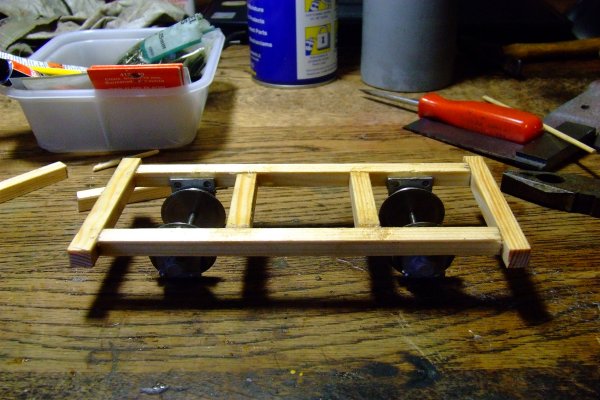
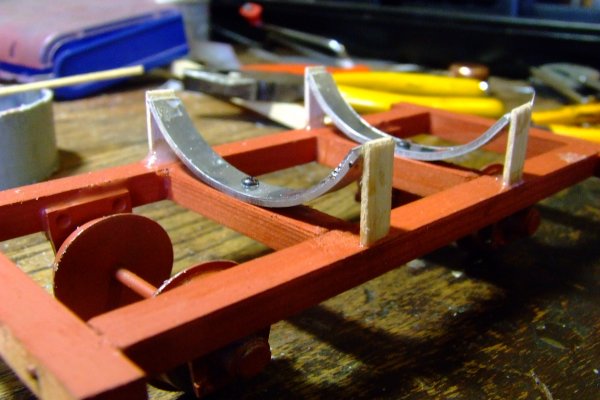
Wheel sets were added and the whole thing given a coat of primer. Cradles for the tank were made out of some ali strip and balsa, glued and screwed to the cross members.
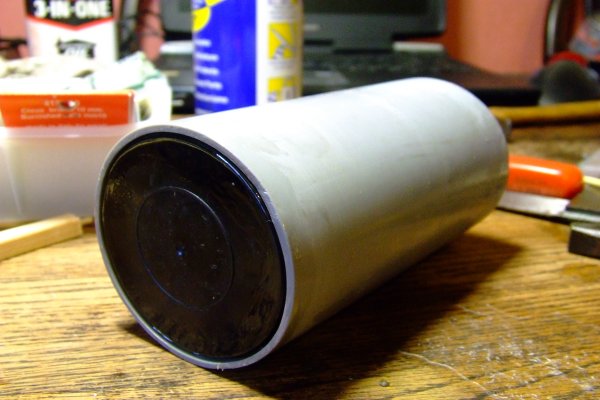
Meanwhile, the tank was knocked up from a bit of old drain pipe. The end caps are lids from spray cans, nothing is wasted here at the MPLR!
End supports were made from 2mm cross section softwood from the local model shop, I always knew I would find a use for it sooner or later. Rivets are small panel pins. Other fittings were made out of anything that seemed to fit the bill. The filler lid is a bit off of an old servo motor, the fuel pipe is an off cut of wire, hand wheel is an old broken brake stand and so on. After spraying the chassis corporate grey and the tank matt black the whole lot was epoxied together.
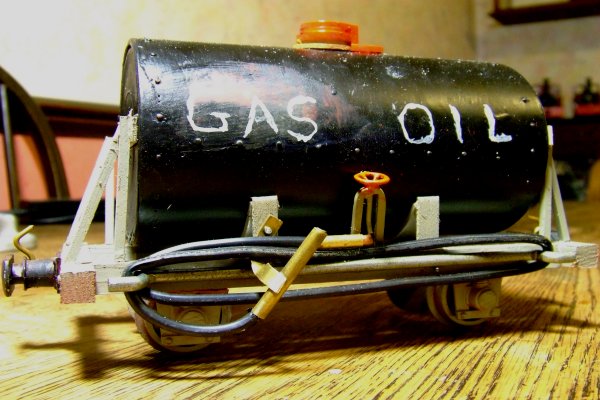
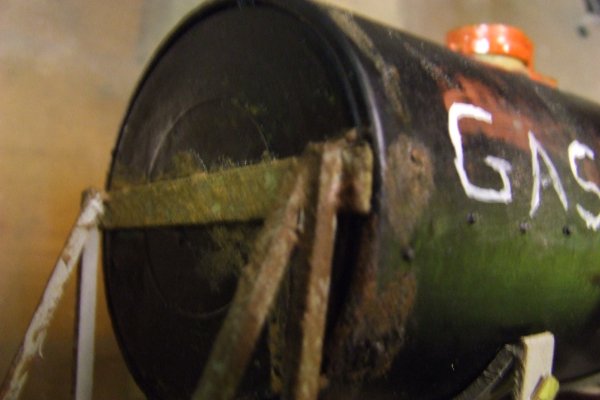
Still rather excited about ‘instant rust’, we felt compelled to have a go. Rust was added here and there for that ‘used’ look.
The final object…
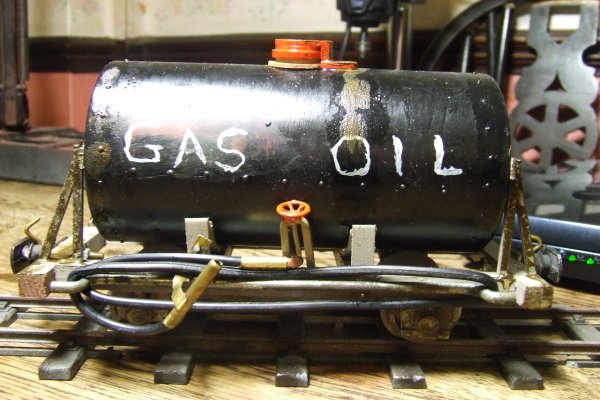
… not to everybodies taste, but this is the first total scratch build we have had a go at. Total cost £nil. (not including the days labour, of course). So who can complain. We think it will look just the job out on the railway. Look out for it doing its stuff!
==========================================================
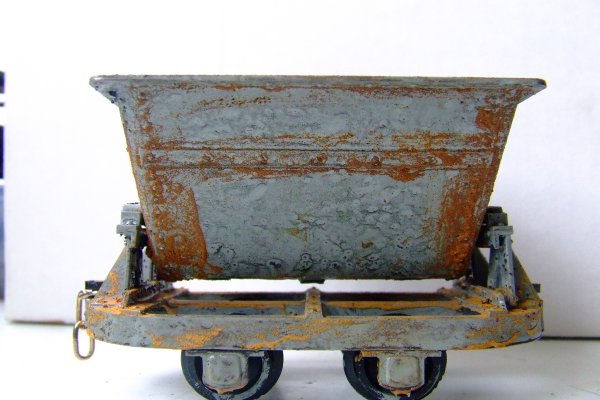
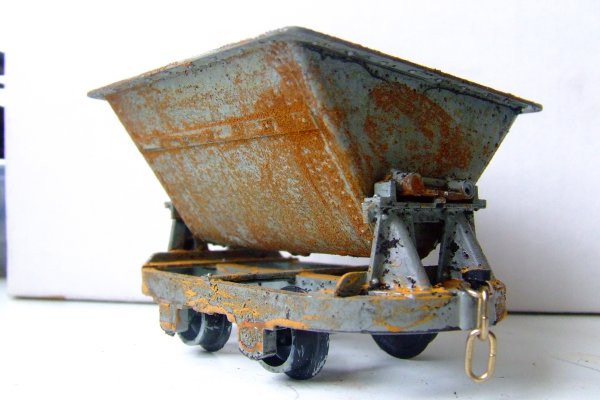
Talking of ‘instant rust’ here is another shot of the new skip wagons, all rusted up. This stuff comes in a three pack kit. A sort of runny PVA type glue, iron powder (not regular filings) and an acidic ’starter’ solution. Over about 48 hours it just keeps getting better. It seems very hardwearing, but only time will tell.
==========================================================
Locolines ‘Tiny’ kit building
Well, I blame Father Christmas for the next article. He delivered a ‘Tiny’ kit to the Financial Director of the MPLR and this is what happened…
To begin; the Locolines kits are made from cardboard. Yes cardboard, but before you run away with the idea that that means flimsy wobbly toys consider this, back in the dark ages of this hobby, cardboard engines and rolling stock were a lot more common than they are today. They are light, realisitic looking and CHEAP! The Locolines kits are very heavy duty indeed, the instructions are clear and simple and kit bashing them is a doddle and great fun. Here is what the Financial Controller (FC) did with hers…
To begin at the beginning, the chassis is a ‘deluxe’ kit fro IP Engineering. Superb quality, four wheel drive and so on. The FC nearly threw this up the garden but she did get the hang of ‘quatering’ eventually

Added to this is an IP speed controller. The part finished kit is bolted in three places onto the chassis. Then the fun started. FC thought that as supplied the Locolines Tiny cab looked a bit big, so she decided to shorten it! This meant lengthening the boiler with a lenght of plastic drain pipe and while this was going on she discovered that a lid from a jar of spices fitted perfectly and made a really good smoke box door. See below…
The two 9v batteries are fitted in the boiler. Neat eh!.
Not content with that, the FC had the bright idea of fitting a bulb and red crinkly paper into the firebox so that when the motor is turned on the coal lights up…
Then she added real coal all over the place…
and some rather nice rivet detail on the smoke box and buffer beams…
Still not fed up with bashing the Locolines kit, she then had the idea of ‘working’ pistons and valve gear. She nagged the workshop staff until they produced this…
… but it was worth it to see the smile on her face!
So, all in all, after lots of fun, tears, trial and error and problem solving we end up with a little loco that cost well under £100, looks the part, taught all of us a lot and is something our 16mm garden railway forebears would have approved of!
Oh, then she added a sound module, so ‘Noel’ chuffs and hisses as he chugs around.
All that now remains is to add hand rails, numbers and so on and the MPLR has it’s lates loco ready to go.
=========================================================